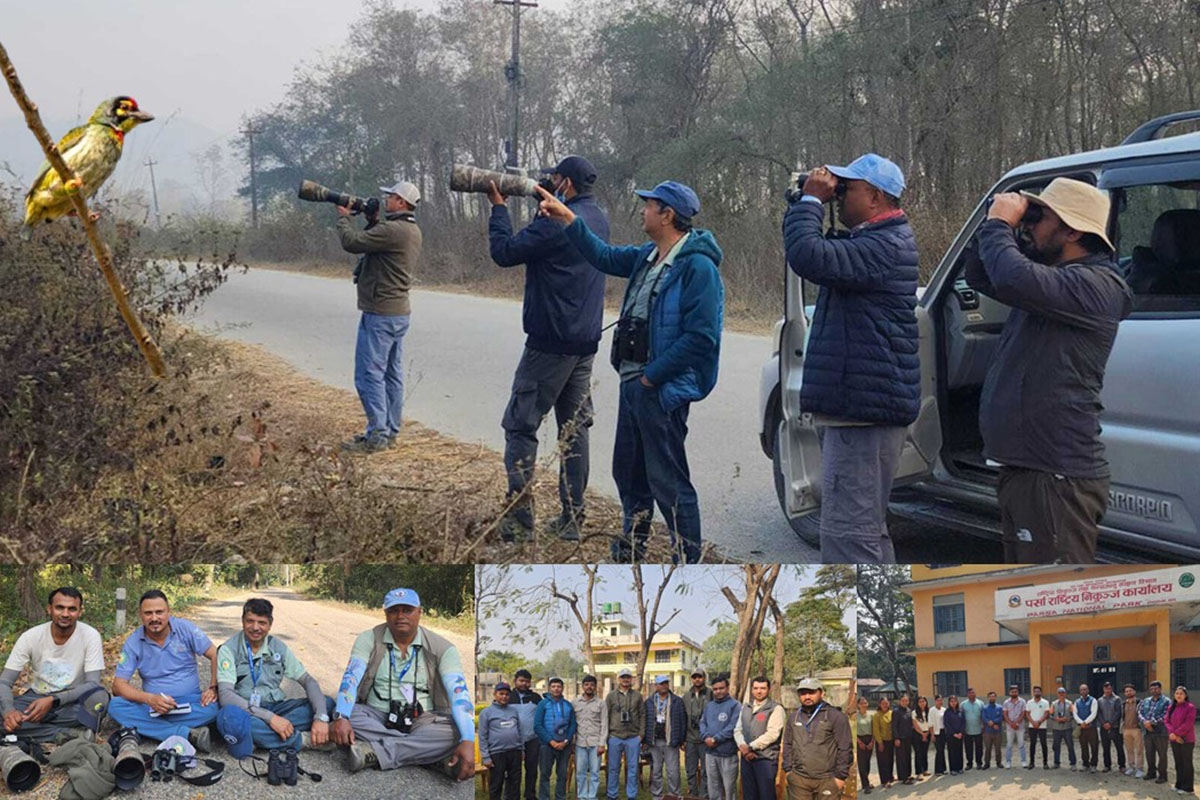
A comprehensive bird survey, conducted across Madhesh Province from February 11 to 24, 2026, recorded 17,091 individual birds representing 291 species from 20 orders and 70 families. The field research was a joint effort between the Nepalese Ornithological Union (NOU), which provided technical expertise, and the Mithila Wildlife Trust (MWT), which provided financial backing.
The field survey was executed by a dedicated team of leading experts and conservationists:
From NOU: Hathan Chaudhary, Manshanta Ghimire, Laxman Prasad Poudyal, and Suraj Baral.
From MWT: Dev Narayan Mandal, Amarnath Yadav, and Subodh Acharya.
From Koshi Bird Society: Chakra Timsina.
The research was conducted under official permissions from the Department of National Parks and Wildlife Conservation (DNPWC) and the Department of Forest and Soil Conservation. The team worked in close coordination with Parsa National Park, Koshi Tappu Wildlife Reserve, and the Division Forest Offices of all eight districts in the province: Parsa, Bara, Rautahat, Sarlahi, Mahottari, Dhanusha, Siraha, and Saptari.
To ensure high scientific accuracy, the research team utilized a multi-phase approach to map out and study the province's bird life. During a preliminary survey in December 2025, the team identified biodiversity hotspots and established survey routes based on expert consultations, historical literature, and geographical maps. Following this, the primary field study was conducted in February 2026. This core survey was executed using MacKinnon’s species richness counting method, with data gathered through direct observations along walking trails, roads, and surrounding habitats across all eight districts of Madhesh Province.
The survey team explored a wide matrix of landscapes across the Terai and Chure regions, categorizing them into four major habitat types.
Wetlands: Key aquatic ecosystems include the western sector of Koshi Tappu Wildlife Reserve, the Koshi River stretches, the Bagmati, Kamala, and Triyuga river systems, farmland fishponds, and various oxbow and man-made lakes.
Forests: Crucial biological corridors in the Chure Range connecting Parsa National Park and Koshi Tappu Wildlife Reserve, alongside forest patches along the East-West Highway.
Grasslands: Floodplain grasslands of major rivers; specific protected grasslands like Rambhori and Bhata (Parsa National Park) and Pathari (Koshi Tappu); and open fields interspersed with farmlands.
Human Habitations & Farmlands: Major sugarcane and crop belts, fallow lands, village and urban settlements, and infrastructure environments like electric poles and wires.
The survey prioritized recognized Important Bird and Biodiversity Areas (IBAs) and ecologically significant sites within the province. Key surveyed areas included the peripheries of Parsa and Chitwan National Parks (such as Thori, Nirmal Basti, Bhata, Halkhoriya Daha, and the Nijgadh forest), the Janakinagar-Murtiya farmlands, and the forest-grassland mosaics of Kolhabi and Baragadhi. Additionally, the team covered the biologically and culturally vital Dhanushadham Protected Forest, alongside the western section of the Koshi Tappu Wildlife Reserve and the globally recognized Koshi Barrage.
During the field survey, researchers recorded 28 nationally threatened and seven globally threatened bird species, including the Bengal Florican, White-rumped Vulture, Yellow-breasted Bunting, Steppe Eagle, Grey-crowned Prinia, Common Pochard, and Black-capped Kingfisher. A total of 41 species listed in the CITES Appendices were documented. This includes two species from Appendix I and 39 from Appendix II, with notable sightings of the Common Hill Myna, Bengal Florican, Black Stork, and Peregrine Falcon.
The summer bird survey is scheduled for June 2026. 